
Services
B2B Email Segmentation Services
Sending the same message to everyone kills your reply rate. B2B email segmentation divides your audience into tight, specific groups based on their exact pain points. By splitting your list by role, industry, or intent, we make sure your copywriting hits home every single time.
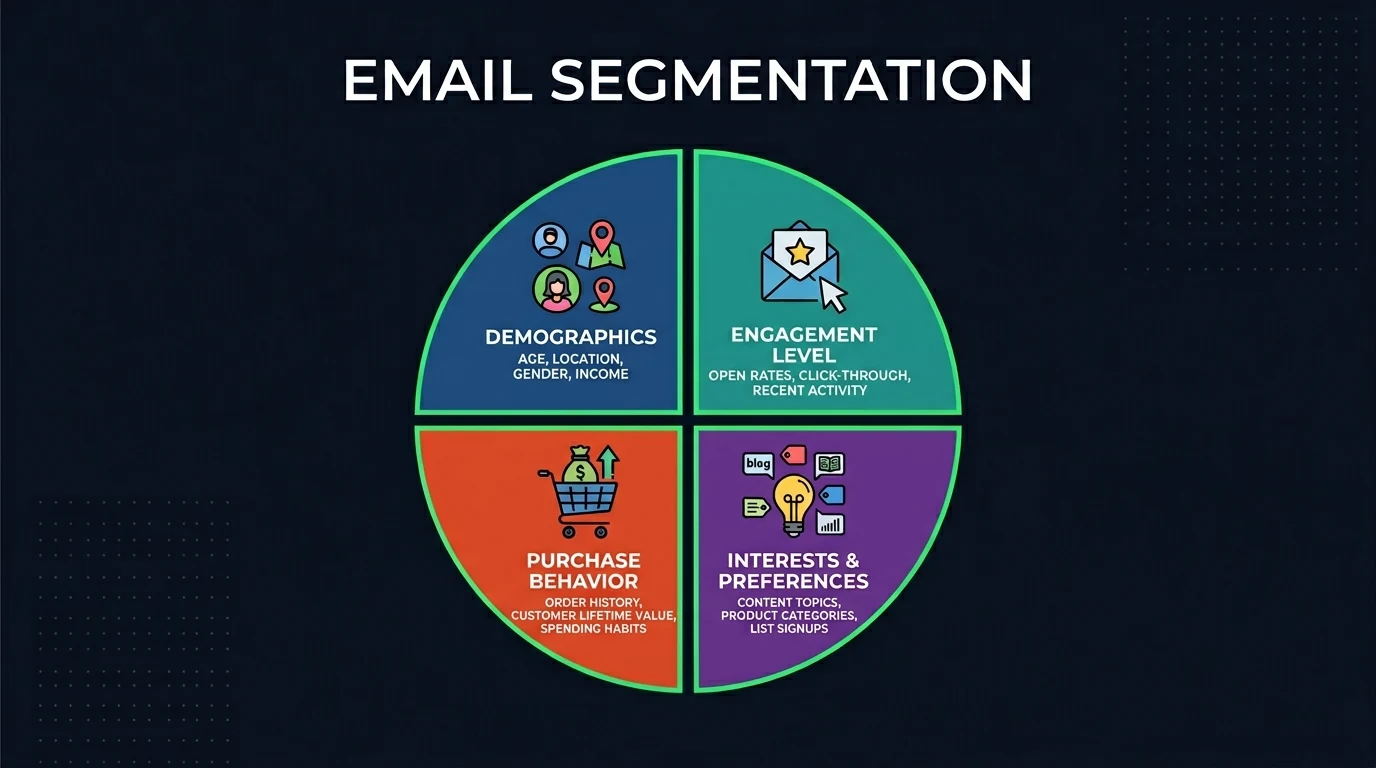
The Shift That Matters
Why B2B Email Segmentation Services Matters
Founders care about revenue; operators care about efficiency. If you send them the same email, they both delete it. Proper segmentation matches the message to the specific buyer. It is the fastest way to avoid a low response rate.
More relevant copy
Segments give the message a clearer buyer problem and a more specific offer angle.
Cleaner testing
It is easier to learn what works when audience groups are defined properly and not mixed together.
Better lead quality
Segmentation helps the campaign attract replies from accounts that match the intended service fit more closely.
Challenges
What Problems B2B Email Segmentation Services Solves
This service solves the relevance problem that shows up when a campaign tries to use one message for too many different buyer contexts. The more mixed the audience, the weaker the learning and the weaker the conversion path usually becomes.
Weak targeting structure
When lists are broad, reply quality suffers. We segment by role, industry, company profile, buying context, and problem type so targeting becomes more precise and the message can become more useful.
What changes after the fix
Once this issue is fixed, the campaign becomes easier to read, easier to optimize, and much more commercially useful.
Low deliverability from mixed engagement
Better segmentation usually improves engagement, and better engagement helps support sender health over time. Mixed audiences often create weaker engagement patterns that distort deliverability signals.
What this protects
Fixing this issue protects reply quality, inbox health, and the overall conversion path from first touch to booked call.
How We Improve Results With B2B Email Segmentation Services
Segmentation improves conversion by helping the campaign say the right thing to the right person at the right level of specificity. The point is not complexity. The point is relevance that the buyer can recognize immediately.
Role-based relevance
A founder, an operations leader, and a sales director do not need the same message even inside the same company type.
Industry fit
Industry segmentation helps the campaign name more credible business pain and more accurate use cases.
Offer alignment
Different segments often need different offer framing even when the underlying service stays the same.
What Is Included
What Is Included In Our B2B Email Segmentation Services Service
We map out your ideal client profiles and split your data accordingly. This creates a clear roadmap for your sequence writing and ensures your campaign logic makes sense.
Strategy and setup
We map the segments that matter most based on ICP fit, personas, industries, company profile, technology usage, CRM stage, and offer differences before the campaign goes live.
Execution and optimization
We structure the list, apply segment logic, and refine groups based on campaign data, reply patterns, and conversion quality.
Reporting and handoff
We show which segments perform best so future campaigns, follow-up, and sales handoff can stay aligned with what the market is actually responding to.
Best Fit
What Should Be Segmented First
The best first segmentation layers are usually buyer role, industry, company profile, and the problem your offer solves. Those categories change how the prospect sees the value of the conversation. They are far more useful than random list slicing or cosmetic segmentation.
Best-fit signs
This service fits teams that already have data but cannot turn that data into sharper campaigns.
Business Impact
How Segmentation Improves Conversion
Segmentation is what turns one broad outreach list into several more useful conversations. It gives the campaign structure, makes testing easier, and helps the copy speak to sharper business conditions instead of generic market language.
Better market clarity
Segmentation reveals which pockets of the market respond best, which groups convert poorly, and where the offer needs stronger positioning.
Less message dilution
Without segmentation, companies often write one vague sequence for everyone. That broad approach lowers relevance because the message has to stay too general to fit any one buyer well.
Smarter sequence variants
Segments make it easier to build targeted variants by industry, company size, buyer role, or operational pain. That usually produces more useful testing and better-quality responses.
More efficient scaling
When segmentation is already in place, scaling becomes safer because the campaign expands through known audience groups instead of pushing more volume into a mixed and blurry market.
Specific Use Cases
Where Segmentation Becomes a Growth Lever
Segmentation is required when you are forcing one generic message onto too many buyer types, resulting in weak meeting quality.
Mixed audiences inside one sequence
A sequence sent to founders, COOs, and marketing leaders at the same time usually underperforms because each segment cares about a different pain and buying trigger. A structured segmentation strategy separates them.
Decent reply volume but weak-fit meetings
Segmentation is often the fix when teams see responses but the calls are misaligned, underqualified, or too far from the real ideal client profile, which is essentially a bad lead quality issue.
Markets with multiple offer angles
If the same service can solve different pains for different verticals like SaaS and accounting, segmentation helps the team separate those conversations before the copy gets written.
Related Pages
Helpful Pages After Segmentation Services
These pages help if you want the strategic logic behind segmentation, the list workflow feeding it, or the diagnostic path when lead quality is still weak.