
Strategy
B2B Email Segmentation
How to segment B2B email campaigns for better targeting and conversion.
A strong B2B email segmentation strategy divides the market into meaningful audience groups so the campaign can use more relevant messaging and cleaner testing. The next pages usually sit in Segmentation Services, List Building, and the downstream diagnosis of Bad Lead Quality.
Core Framework
The Framework Behind B2B Email Segmentation
A good B2B email segmentation strategy starts by dividing the market into groups that change the message in a meaningful way. The goal is not to create more spreadsheet columns. The goal is to build audience buckets that support better positioning, cleaner tests, and stronger reply quality. A segmentation service can build this for you.
Choose the right segment logic
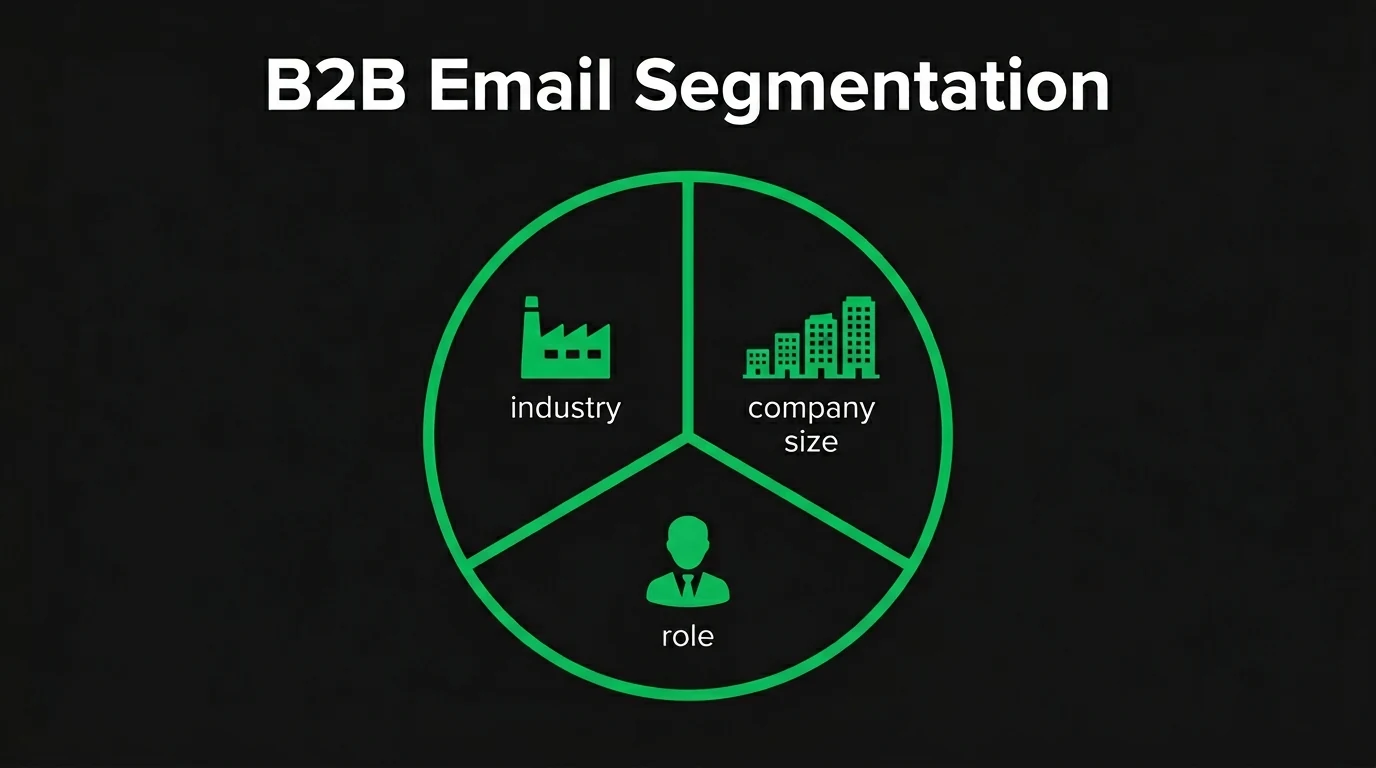
Start with segment layers that actually change the buying context. The most useful ones are usually buyer role, industry, company size, service need, technology stack, or CRM stage.
Map the message by segment
Each segment should receive a message that reflects its own business pressure. Founders, RevOps leaders, operations managers, and department heads rarely respond to the same wording for the same reasons.
Review performance by audience group
Segmentation only becomes strategic when results are measured by segment. That is what reveals which parts of the market deserve more volume, more testing, or a different offer angle.
Key Principles
What Makes This Strategy Work
Segmentation works when it increases relevance without turning the campaign into operational chaos. The point is to make the market easier to understand and easier to address, not to create needless complexity, and to support better personalization.
Segment for commercial meaning
The best segments reflect differences in buying context. Segmenting by company size, buyer role, account maturity, or service need usually tells you more than arbitrary list slicing.
Why this matters
Good strategy works when the campaign is built on sound sequencing, sound targeting, and infrastructure that can support the volume safely.
Keep the segment tied to message changes
A segment only matters if it changes the copy, the CTA, the sequence angle, or the priority of the account. If nothing changes after the split, the segment is probably not useful enough.
What this improves
When this principle is handled correctly, testing becomes cleaner, reporting becomes more useful, and the campaign becomes easier to scale responsibly.
How To Execute B2B Email Segmentation Well
The execution side of segmentation should stay focused on audience structure, messaging alignment, and performance review. This page should not drift into generic infrastructure talk unless it directly affects how lists are being used.
Build the segment structure first
Define the primary audience groups before writing the campaign. That usually means choosing the segment rules, naming the segments clearly, and deciding what makes one bucket meaningfully different from another.
Write segment-specific variants
Once the groups are defined, adjust the message by pain point, buyer role, or account condition. The sequence should reflect the segment logic rather than forcing one generic message onto every buyer type.
Review performance by segment
Track reply quality, meeting quality, and conversion quality by audience group. That is what tells you whether the segmentation is actually improving testing clarity and buyer fit.
Practical Checklist
What To Check Before You Scale B2B Email Segmentation
Before scaling B2B email segmentation, confirm that each segment has a real commercial reason to exist. Check the segment rules, data quality, buyer-role clarity, message variation, and reporting logic so the campaign does not create complexity without improving relevance. If the list is weak, move first into list building. If the message is weak after the split, move into personalization.
Quick audit focus
Ask one blunt question for every segment: does this audience deserve a different message, different CTA, or different sales expectation? If the answer is no, the segment may be too thin or too cosmetic.
Common Mistakes
Common B2B Email Segmentation Mistakes
Most segmentation problems come from either overcomplicating the audience structure or keeping it so broad that the message stays generic. The strongest campaigns sit in the middle: enough segmentation to improve relevance for copywriting, but not so much that the system becomes brittle.
Creating segments with no message change
If a segment does not change the copy, sequence, CTA, or qualification logic, it is probably not adding much strategic value.
Using too many thin segments
Over-segmentation creates tiny buckets that are hard to test and hard to learn from. The result is often complexity without enough volume to produce useful signal.
Ignoring buyer-role differences
A founder, a RevOps leader, and a department head often need different framing. Ignoring that difference weakens reply quality even when the list itself is technically accurate.
Failing to read performance by group
If all results are rolled up together, the team cannot tell which segment is carrying performance and which one is dragging the campaign down.
Turn Strategy Into Execution
Best Next Pages After B2B Email Segmentation
Use these pages to move from strategy into services, tools, industry examples, and the exact problems that usually connect to this topic.